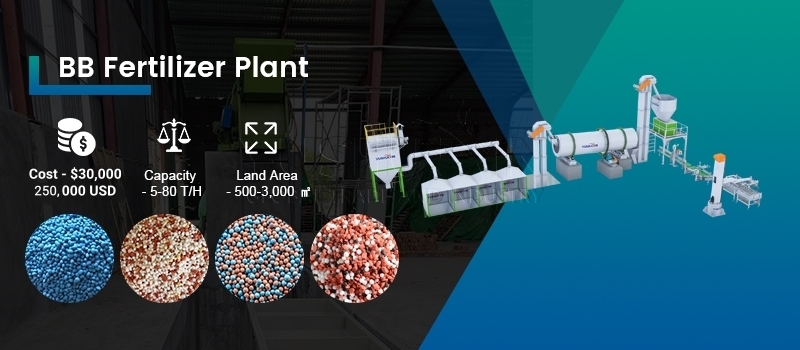
The cost structure of a BB fertilizer plant often depends on the selection and configuration of machinery. Every piece of equipment—from batching machines to blending systems—affects both investment and efficiency. When investors or entrepreneurs plan to build a fertilizer plant, they need to understand how machinery choices shape not only production capacity but also operational stability and long-term maintenance expenses. In the production of bulk blend fertilizer, raw material preparation, blending precision, and packaging speed together influence the overall fertilizer manufacturing plant cost. Therefore, a systematic analysis of machinery selection becomes essential for anyone aiming to set up a competitive fertilizer production plant within a reasonable budget.
1. What Raw Materials Are Suitable for BB Fertilizer Production?
Raw materials significantly impact both the formulation and the mechanical design of a bulk blending fertilizer line. Granular urea, ammonium sulfate, monoammonium phosphate (MAP), diammonium phosphate (DAP), and potassium chloride (KCl) are widely used because these materials maintain uniform particle size and flow smoothly through blending machines. Each raw material type affects how the batching and mixing machinery operates. For example, if a BB fertilizer factory uses several granular fertilizers with different densities, the blending equipment must provide accurate weighing and controlled discharge to avoid segregation. Furthermore, the selection of raw materials determines the necessary capacity of automatic batching systems and bucket elevators. When investors consider fertilizer plant setup, they should evaluate not only the raw material price but also the operational compatibility with BB fertilizer production equipment, as this compatibility directly influences total production cost and final quotation.
2. How Do Machines Shape the Blending and Mixing Process Efficiency?
The blending and mixing procedure stands as the core of any bulk blended fertilizer production line. A well-designed BB fertilizer blender or mixer ensures consistent nutrient distribution, which directly affects product quality and customer satisfaction. A small-capacity BB fertilizer blender suits medium-scale fertilizer factories, while a large drum-type BB fertilizer mixer provides continuous mixing for high-output fertilizer manufacturing plants. The machinery structure, power consumption, and automation level all influence both initial investment and daily operating costs. For instance, high-speed mixing machines may require more energy, but they reduce production time and improve uniformity. In addition, supporting machines such as the automatic batching machine, vertical crusher or chain crusher, and packing machine contribute to efficient material flow and lower labor expenses. When equipment matches the production scale and process requirements, a fertilizer production plant achieves optimal cost-performance balance. Therefore, investors should analyze each machinery feature to control bb fertilizer plant cost effectively.
3. How to Balance Equipment Investment and Plant Operating Cost?
A fertilizer plant budget includes machinery purchase, installation, and long-term operation. Selecting reliable and energy-efficient equipment minimizes maintenance frequency and power consumption, leading to stable cost control. A well-planned bulk blending fertilizer production line not only shortens the return-on-investment period but also ensures continuous output under varying market conditions. Investors need to compare machinery quotations carefully, considering equipment lifespan and spare parts availability. In addition, flexible designs, such as adjustable mixing speed or modular feeding systems, allow a fertilizer factory to upgrade production capacity without complete reconstruction. When evaluating fertilizer plant setup, decision-makers should view machinery choices as an integrated system rather than isolated purchases. This approach helps align capital expenditure with production efficiency, ensuring that the BB fertilizer manufacturing plant cost remains within a sustainable range.
Conclusion
In summary, the cost of building a BB fertilizer factory depends on three interrelated factors: suitable raw materials, efficient blending and mixing machinery, and balanced investment planning. Each element directly influences the operating budget and long-term financial performance of the fertilizer production plant. By selecting appropriate equipment types, investors can enhance production stability, reduce waste, and improve blending accuracy. Professional guidance from a reliable fertilizer equipment manufacturer can further optimize machinery configuration and cost control. Among the experienced suppliers in this field, Yushunxin, a professional fertilizer equipment manufacturer, provides integrated solutions for BB fertilizer production lines that help clients establish efficient and cost-effective fertilizer plants. You can visit: https://www.fertilizerproductequipment.com/bb-fertilizer-plant-cost/