As organic fertilizer markets continue to expand, more producers are upgrading from powdered compost to cow dung biofertilizer granulation lines. Granulated products offer improved handling, uniform nutrient distribution, and better field performance, making pelletized cow manure a preferred form for commercial biofertilizer production.
Cow dung is a stable and widely available organic raw material. When processed correctly, it can be transformed into durable, uniform pellets suitable for long-term storage and mechanized spreading.
Raw Material Preparation Before Granulation
The foundation of any cow dung biofertilizer granulation process is proper fermentation. Fresh cattle manure must undergo aerobic composting to reduce moisture, eliminate harmful pathogens, and stabilize organic matter. Well-fermented cow dung typically has a loose structure, moderate moisture content, and neutral odor.
After fermentation, crushing and screening are applied to ensure consistent particle size. This step is critical for stable granulation and helps avoid uneven pellet formation in downstream processes.
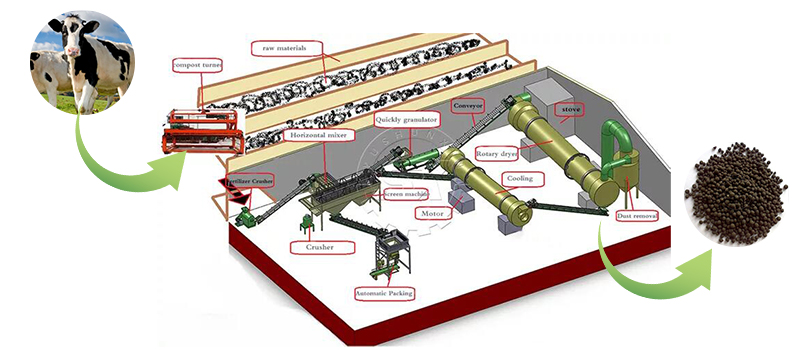
Granulation Process for Cow Dung Biofertilizer
Granulation is the key stage in a cow dung organic fertilizer granulation line. Disc granulators, drum granulators, or roller compaction systems are commonly used, depending on production scale and pellet requirements.
For cow dung-based materials, disc granulation is often favored due to its flexible control of pellet size and smooth pellet surface. During operation, fine particles gradually agglomerate into spherical granules through continuous rolling and layering.
Spraying systems can be integrated into the granulator to apply liquid binders, water, or microbial solutions. This approach not only improves pellet formation but also allows beneficial microorganisms to be evenly distributed on the pellet surface. Learn more!
Methods to Improve Granule Strength and Uniformity
Achieving strong and uniform pellets is a core objective in cow dung biofertilizer pellet production. Several technical factors directly influence granule quality:
Moisture balance plays a decisive role. Excess moisture leads to soft pellets, while insufficient moisture causes poor agglomeration. Maintaining a stable moisture range ensures consistent pellet growth.
Binder selection and application method also affect pellet hardness. Organic binders or liquid additives help enhance inter-particle bonding without compromising fertilizer performance.
Equipment parameter adjustment—including disc angle, rotational speed, and feed rate—allows producers to fine-tune pellet size distribution and reduce fines.
Drying and Finishing of Biofertilizer Pellets
After granulation, pellets typically pass through drying and cooling stages. Drying removes excess moisture and significantly increases pellet strength, while cooling stabilizes the structure before screening.
Final screening ensures uniform particle size, producing a market-ready cow dung bio organic fertilizer pellet suitable for packaging or bulk distribution. YUSHUNXIN can provide you with the cow dung biofertilizer processing machine, welcome to consult!
Conclusion
A well-designed cow dung biofertilizer granulation line enables producers to convert composted cattle manure into high-quality organic fertilizer pellets. By focusing on fermentation quality, moisture control, and granulation optimization, manufacturers can achieve stable production and consistent pellet performance. If you need a cow dung biofertilizer granulation project, welcome to visit: https://www.biofertilizerproduction.com/product/cow-dung-biofertilizer-making-line/