Buying an industrial freeze dryer involves more than comparing chamber size or purchase price. The right manufacturer should help you build a production system that delivers stable drying results, matches your target output, and connects smoothly with upstream and downstream equipment.
Before placing an order, focus on the manufacturer’s engineering capability, equipment configuration, production-line integration, and technical support. HADOF can configure a solution around your raw materials, production capacity, and available factory space, so you do not need to plan every technical detail yourself.
Here are five practical questions that can help you evaluate a freeze dryer manufacturer.
1. Can You Match the Freeze Dryer to My Production Capacity?
The first question should focus on actual production capacity rather than simply asking for the largest machine.
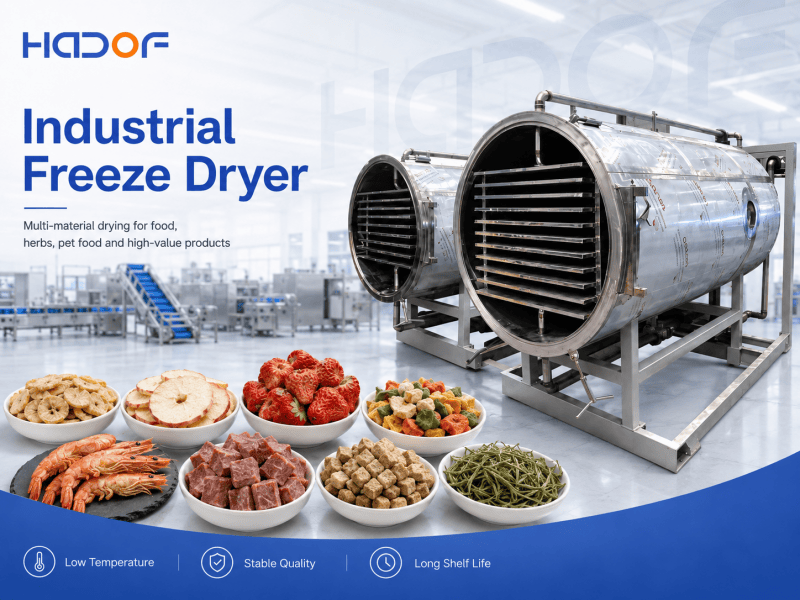
An industrial freeze dryer machine needs enough shelf area, refrigeration capacity, condenser performance, and vacuum capacity to handle the planned batch load.
A machine that cannot handle enough material may create production bottlenecks. An unnecessarily large system can increase equipment investment and operating costs.
A capable manufacturer should therefore match the freeze dryer to your raw material and production target instead of recommending equipment based only on chamber size.
HADOF offers different industrial freeze-drying configurations and can adjust the system according to different production requirements. Its larger commercial systems can also connect with washing, cutting, freezing, and other food-processing equipment.
2. What Does the Freeze Dryer Configuration Include?
Two freeze dryers may look similar from the outside but use very different internal configurations.
Ask the manufacturer to explain the refrigeration system, vacuum system, condenser, shelf heating system, control system, and material-contact parts.
These components directly affect how the machine freezes products, maintains vacuum conditions, removes water vapor, and controls the drying cycle.
A reliable industrial vacuum freeze dryer should provide coordinated temperature, vacuum, condensation, and heating performance rather than relying on one strong component while other systems limit production.
This question also helps you compare quotations more accurately. A lower price may reflect differences in drying area, condenser capacity, vacuum configuration, control functions, or supporting equipment rather than a simple price difference.
3. Can You Supply the Equipment Around the Freeze Dryer?
Commercial freeze-drying often requires much more than one freeze dryer.
For fruits and vegetables, production may include sorting, washing, cutting, blanching, draining, freezing, freeze drying, inspection, and packaging. HADOF presents similar integrated processing flows for commercial freeze-dried food production.
For example, a leafy vegetable slicer helps control product dimensions before freezing and drying. More uniform pieces can support a more consistent production process.
A vegetable blanching machine can add the required heat-treatment stage for products that use blanching before freezing.
For raw material inspection, a manual sorting platform helps operators remove unsuitable materials and connects washing, cutting, and conveying sections.
A manufacturer that supplies these supporting systems can coordinate equipment capacity and reduce unnecessary manual transfers between individual machines.
4. Can You Integrate Pre-Freezing With Freeze Drying?
Pre-freezing can become an important production bottleneck when commercial output increases.
Ask whether the manufacturer can coordinate quick freezing with the freeze dryer rather than treating both processes as completely separate systems.
An Liquid Nitrogen Quick Freezing Machine can provide continuous, uniform freezing and connect with washing, slicing, blanching, conveying, and packaging equipment. HADOF’s quick freezer range includes multiple capacity configurations for different production requirements.
With the right layout, the freezing section can prepare the next batch while the freeze dryer processes the current batch. This arrangement reduces waiting between stages and helps the factory maintain a smoother production rhythm.
The manufacturer should design the freezing and freeze-drying sections as connected parts of the same workflow.
5. Can You Help With Factory Layout and Complete Line Integration?
A good freeze dryer can still perform poorly inside an inefficient factory layout.
Long transfer distances, limited loading space, poorly positioned preparation equipment, and mismatched upstream capacity can increase labor and reduce daily output.
Ask whether the manufacturer can plan equipment positions and connections around your existing workshop.
HADOF states that its freeze-drying solutions can combine washing, cutting, quick freezing, vacuum freeze drying, and packaging around product type, capacity, and factory layout.
This approach means you do not need to design every production stage independently. The production line can follow your raw materials, target output, and available factory area while leaving room for practical operation, cleaning, maintenance, and future expansion.
Choose a Freeze Dryer Manufacturer That Can Support the Whole Process
The best quotation does not simply offer a freeze dryer at an attractive price. It should provide the right drying capacity, reliable core systems, suitable auxiliary equipment, smooth freezing integration, and a practical factory layout.
These five questions help you understand whether a manufacturer can solve common problems such as insufficient output, unstable production, excessive manual handling, poor equipment coordination, and difficult future expansion.
If you need a customized freeze-drying solution based on your raw materials, production capacity, and factory space, please visit the HADOF Freeze Dryer homepage for more information:https://www.freezehadof.com