Fruit processors often face the same decision: preserve the harvest with individual quick freezing (IQF) or with freeze drying? Both methods keep fruit out of season and both can be profitable, but they produce very different products for very different customers. Choosing the wrong one can mean a product that does not fit the market, or a cost structure that never pays back. This guide compares the two methods and explains how to choose.
What IQF Does
IQF, or individually quick frozen, freezes each piece of fruit separately so it does not clump into a block. The fruit keeps much of its fresh texture and color, and it is stored and shipped frozen. IQF is fast, well understood, and widely used for smoothies, baking, and further processing. Its limitation is the cold chain: from the factory to the customer, the product must stay frozen, and any thawing damages texture and quality.
What Freeze Drying Does
Freeze drying freezes the fruit and then removes the ice through sublimation under vacuum. Because the water is removed rather than frozen in place, the fruit becomes light, crisp, and shelf-stable at room temperature. It keeps its shape, color, and much of its nutrition, and it rehydrates quickly. The trade-off is a longer, more energy-intensive process and a higher cost per kilogram — which is why freeze-dried fruit is usually positioned as a premium product.
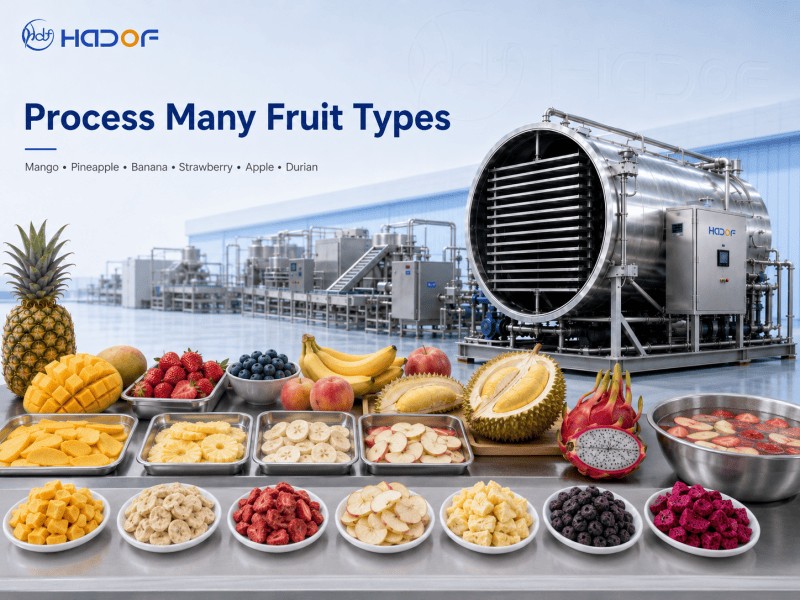
A Freeze Dried Fruit Production Line process many fruit types
Key Differences
The two products differ in several important ways:
- Storage and shipping: IQF needs a cold chain; freeze-dried fruit ships at ambient temperature and is far lighter.
- Texture: IQF thaws to a soft, fresh-like texture; freeze-dried fruit stays crisp and porous.
- Shelf life: freeze-dried fruit typically stores for years; IQF depends on uninterrupted freezing.
- Rehydration: freeze-dried fruit rehydrates quickly in water, yogurt, or batter; IQF releases water as it thaws.
- Cost: IQF has a lower processing cost; freeze drying has a higher cost per kilogram but supports premium pricing.
- Applications: IQF suits smoothies, baking, and further processing; freeze drying suits snacks, cereals, and instant ingredients.
How the Two Methods Work
IQF and freeze drying differ from the first step. IQF freezes fruit quickly and then keeps it frozen; the product is ready as soon as it leaves the freezer, and the rest of the line is mainly packaging and cold storage. Freeze drying adds two more stages: the frozen fruit is placed in a vacuum chamber, and the ice is removed by sublimation over a long cycle. That extra step is what makes the product shelf-stable, but it also explains the higher cost and the need for a dedicated dryer and condenser.
Choosing by Product and Customer
The best method depends on who buys the fruit and how they use it. A bakery that folds fruit into dough usually prefers IQF because the pieces behave like fresh fruit. A snack brand that sells shelf-stable packs prefers freeze-dried fruit because it stays crisp without refrigeration. An exporter shipping to distant markets often chooses freeze drying because the product is light and does not need a cold chain. Start with the customer and the use case, then choose the process that fits.
When to Choose IQF
Choose IQF when your customers need fruit that behaves like fresh fruit after thawing, when your market already has a reliable cold chain, and when cost per kilogram matters more than shelf stability. IQF is also a good fit when the fruit will be processed further, because the frozen pieces can be blended or cooked directly.
When to Choose Freeze Drying
Choose freeze drying when your product needs to sit on a shelf, travel long distances, or carry a premium price. A freeze-dried fruit production line produces light, crisp fruit for snacks, cereal inclusions, and instant ingredients, and the product does not depend on refrigeration. For exporters and premium brands, that combination is often the deciding factor. Our guide to freeze drying vs. IQF freezing explains the technical differences in more detail.
Can You Do Both?
Yes. Many fruit factories run both IQF and freeze drying for different products or different customers. The same harvest can be split: part goes to IQF for local foodservice, part goes to freeze drying for premium retail and export. Running both requires careful planning, because the two lines have different space, energy, and staffing needs, but it can widen the market you serve.
Common Mistakes
The first mistake is choosing a method before defining the customer and the product format. The second is comparing only processing cost and ignoring storage, shipping, and shelf life. The third is under-sizing the freeze dryer and expecting IQF-level throughput. The fourth is assuming freeze-dried fruit will replace IQF everywhere; the two products serve different needs. Finally, poor packaging for freeze-dried fruit quickly destroys its crisp texture, so the packaging decision belongs in the plan from the start.
Conclusion
Freeze-dried fruit and IQF fruit are not competitors so much as different tools. IQF preserves a fresh-like product for the cold chain, while freeze drying creates a light, shelf-stable, premium product. The right choice depends on your customers, your logistics, and your pricing. HADOF Food Processing Manufacture supplies industrial freeze dryers and complete production lines for freeze-dried fruit. Tell us your product and market, and we will help you plan the right system.