Designing a 20 t/h NPK bulk blending fertilizer production line requires clear planning of raw material selection, npk mixing technology, and fertilizer plant investment control. A fertilizer investor or plant manager gains stable quality and competitive price advantages only when the npk blending fertilizer process matches the required capacity, automation level, and local market demand. Therefore, a rational BB fertilizer factory layout, a reliable bulk blended fertilizer production procedure, and a balanced project budget together form the core of an efficient npk fertilizer manufacturing solution.
What Raw Materials Suit 20 T/H BB Fertilizer Production?
A 20 t/h BB fertilizer production plant usually relies on multiple granular raw materials that blend uniformly without additional granulation. A project owner commonly chooses high-quality granular nitrogen, phosphate, and potash sources for npk blended fertilizer preparation. For example, urea, ammonium sulfate, ammonium chloride, and ammonium nitrate often provide nitrogen; monoammonium phosphate (MAP), diammonium phosphate (DAP), and triple superphosphate (TSP) usually serve as phosphate sources; muriate of potash (MOP) and sulfate of potash (SOP) frequently act as potassium sources. These raw materials support flexible bulk blending fertilizer formulations for different crops and soils.
In addition, a BB fertilizer manufacturer often introduces granular micronutrients or conditioners into the npk mixed fertilizer process. Raw materials such as zinc sulfate granules, boron-containing granules, magnesium sulfate granules, and humic acid-based granules allow the bulk blended fertilizer plant to upgrade its product line. A fertilizer factory owner can then design various npk blending formulas for high-value crops, protected cultivation, or special soil conditions. Because the raw materials already exist in granular form, the bulk blending fertilizer production line does not need a complex granulation machine; instead, it focuses on precise batching, uniform mixing, and dust-controlled conveying, which reduces fertilizer manufacturing plant cost and shortens project construction time.
How Does the Bulk Blending NPK Mixing Process Shape Plant Layout and Capacity?
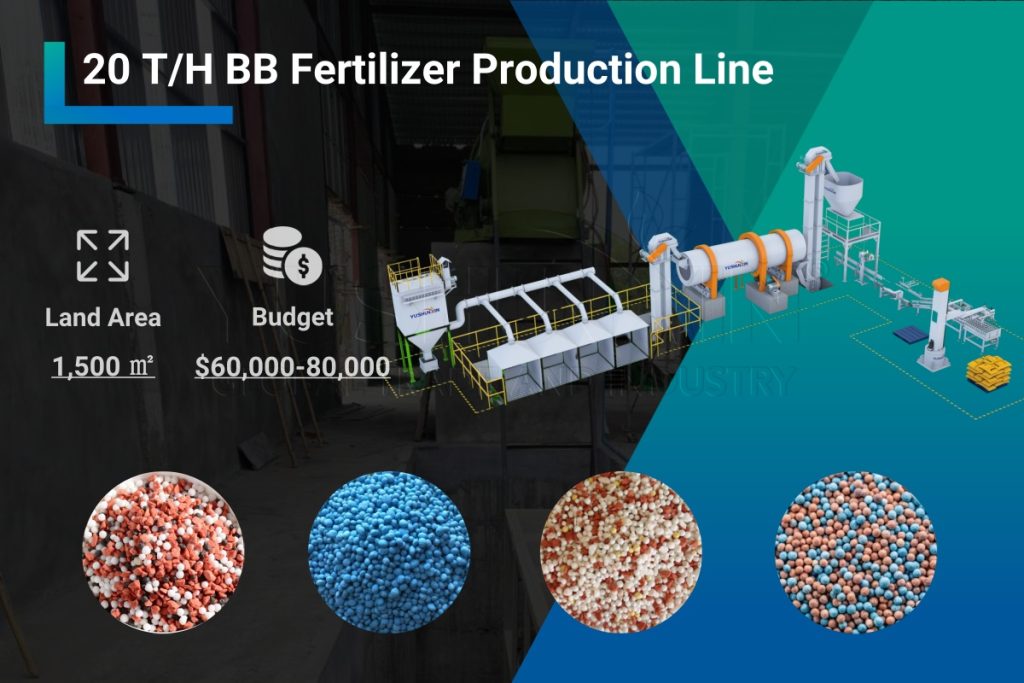
The blending process stands at the center of any bulk blending fertilizer manufacturing project, especially for a 20 t/h NPK fertilizer mixing production line. A typical BB fertilizer plant layout usually follows a clear sequence: raw material receiving and temporary storage, possible crushing of oversize granules, automatic or static batching, vertical conveying, npk blending in a dedicated mixer, and final packaging. The design of each procedure directly affects the overall fertilizer plant setup cost, operating stability, and final npk mixed fertilizer quality.
For raw material size adjustment, a crushing machine such as a vertical crusher or a chain crusher sometimes appears in the front section of the line. When certain returned materials or agglomerated granules enter the system, the crusher reduces particle size and improves later npk blending consistency. After that, an automatic batching machine or static batching machine usually controls the proportion of each component. This batching equipment combines weighing sensors, feed hoppers, and discharge gates, so the operator reaches precise N, P, K, and trace element ratios in every batch of bulk blended fertilizer manufacturing.
For vertical material transfer, a bucket elevator often connects ground storage and elevated blending machines. The bucket elevator design allows continuous feeding of multiple materials into the bb fertilizer blender, which stabilizes a 20 t/h capacity requirement. In the core blending section, a small-capacity npk mixer suits low-output lines, while a drum type BB fertilizer mixer usually serves large capacity bulk blending fertilizer preparation. The drum mixer or rotary BB fertilizer blender often provides stable residence time, gentle tumbling, and reliable npk mixed fertilizer homogenization. Meanwhile, proper feeding sequence and rotation speed keep segregation risk low, even when the factory uses raw materials with different bulk densities.
At the end of the NPK bulk blending fertilizer production process, a packing machine fills and seals finished products into bags, usually 25–50 kg. The packing equipment may include automatic weighing scales, bag-clamping devices, and sewing or heat-sealing systems. By coordinating batching machine, bucket elevator, bulk blending mixer, and packing machine, a 20 t/h npk blending fertilizer production line can maintain continuous operation and consistent output. This coordinated machinery configuration also gives the BB fertilizer plant owner clear options to expand capacity or upgrade automation in future phases.
How Can a BB Fertilizer Factory Balance Capacity, Automation, and Cost?
A company that plans to build a 20 t/h bulk blending fertilizer plant often pays close attention to fertilizer manufacturing plant cost and long-term return. The investor usually evaluates several factors together: equipment price, workshop construction, power supply, labor cost, raw material logistics, and future expansion potential. When the designer chooses suitable bb fertilizer equipment and machinery, the project owner can reach a balanced budget that covers both initial quotation and later operating expenses.
For equipment selection, a plant owner often compares different BB fertilizer mixer designs, batching machine configurations, and packing solutions. A fully automatic batching and mixing system requires a higher initial price but reduces labor intensity and improves npk mixing accuracy. In contrast, a semi-automatic bulk blended fertilizer production line reduces investment but needs more workers and careful management. The investor therefore considers local labor cost, product quality requirements, and future market demand before finalizing the fertilizer plant setup plan. Furthermore, the choice of crushing machine type, bucket elevator specification, and packing machine automation level also influences total fertilizer production plant cost.
The layout of the npk blending fertilizer factory plays an important role in long-term efficiency. A compact and logical design shortens material paths, lowers power consumption, and simplifies maintenance. Clear separation between raw material zones, blending zones, and finished product zones supports smoother production management and safer operation. At the same time, an open area for future equipment addition allows the BB fertilizer plant to increase capacity beyond 20 t/h when the market grows. When a supplier provides a detailed quotation that covers bb fertilizer blender, conveyor system, batching equipment, and control system, the investor gains better control over total fertilizer plant cost and payback period.
In markets where customers demand multiple formulas, the ability to change npk mixing ratios quickly becomes a strong advantage. A well-designed bulk blending fertilizer production line normally includes an adjustable control system to switch recipes. This flexibility helps the fertilizer factory respond to seasonal changes, different soil types, and special customer orders without major downtime. As a result, the factory owner can enhance competitiveness, maintain stable product quality, and keep production cost within a reasonable range.
How Does a Professional Equipment Supplier Support 20 T/H NPK Blending Project Success?
A successful 20 t/h bulk blended fertilizer production project depends not only on the investor’s capital but also on professional technical support. When a fertilizer plant designer receives complete guidance on process flow, npk blending ratios, equipment specification, and workshop layout, the whole fertilizer production plant runs more smoothly after installation. Therefore, many investors prefer cooperation with a specialized manufacturer that supplies BB fertilizer machinery, offers customized design drawings, and provides accurate equipment quotation based on detailed capacity and formula requirements.
A professional fertilizer equipment manufacturer—Yushunxin—offers integrated solutions for bb/bulk blending fertilizer production lines, including raw material handling systems, automatic batching machines, bucket elevators, drum type bb fertilizer mixers, and packaging equipment. Through project consultation, layout optimization, and cost analysis, such a supplier supports investors who plan to set up or upgrade a BB fertilizer plant. With appropriate machinery selection and thoughtful design, an investor can establish a 20 t/h npk blending fertilizer factory that delivers stable quality, flexible formulations, and competitive production cost in the long term. You can visit: https://www.fertilizerproductequipment.com/20-t-h-npk-fertilizer-blending-production-line/