A food factory needs a cutting system that matches leaf strength, target piece size, hourly output, and the next production step. Lettuce, cabbage, spinach, celery, leek, scallion, and similar greens do not behave the same under one knife speed or one conveyor speed. An adjustable 1–40 mm leafy vegetable cutting machine gives a fresh-cut processor a practical range for shredded salad mixes, short vegetable segments, longer cooking cuts, and filling preparation. The production team should compare cut consistency, feeding stability, sanitation, labor demand, operating cost, and line balance before a purchase. A suitable food processing machine also needs to connect smoothly with sorting, washing, dewatering, blanching, freezing, mixing, or packaging equipment when the factory runs a continuous food production process.
How Does an Industrial Leafy Greens Cutter with 1–40 mm Adjustment Match Different Raw Materials?
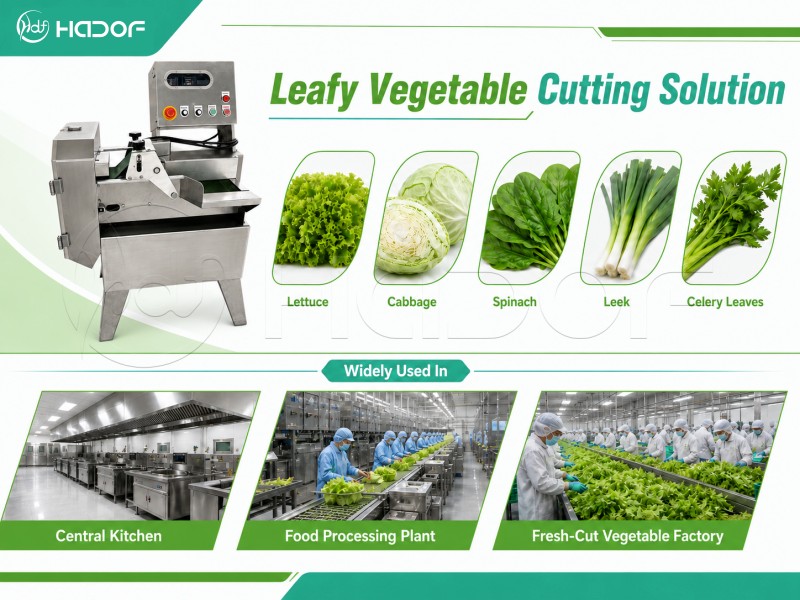
Leaf structure should guide the cutting setting because tender spinach and lettuce need different treatment from firmer cabbage and fibrous celery. The category of leaf vegetables such as lettuce, spinach, and cabbage includes raw materials with different thickness, moisture, stem content, and final product uses. An industrial leafy greens cutter for lettuce and cabbage can change cutting length when the operator coordinates conveyor speed with knife speed. Hadof’s technical information gives a 1–40 mm adjustment range for leafy vegetable cutting. A salad manufacturer may use shorter cuts for mixed salad preparation, while a central kitchen may prefer longer segments for stir-fry or cooked-meal preparation. This flexible food cutting technology helps one food manufacturing system handle several recipes without forcing every raw material into one fixed size.
Why Do Conveyor Speed and Knife Speed Matter in a Continuous Vegetable Chopping Process?
A stable cut depends on the relationship between product feed and blade action. A faster conveyor sends more leaf material toward the knife group, while a different knife speed changes the cut interval. The operator therefore needs a repeatable combination for each product. A continuous conveyor vegetable chopping machine for spinach and celery can support steady food handling when workers spread the raw material evenly on the belt and avoid sudden piles.
Hadof lists Model 802 at 300–800 kg/h and Model 803 at 200–500 kg/h, while both models use 1.1 kW power. The product information also lists a 120 mm conveyor width. These parameters help a buyer match food production capacity with upstream sorting and downstream washing rather than judging machinery only by purchase price. In addition, a stable feeding procedure can reduce cutting variation during busy production periods and improve the consistency of the following washing, mixing, blanching, or packing process.
Should a Fresh-Cut Factory Wash Before Cutting or Cut Before Washing?
The final product should determine the sequence. Hadof’s leafy green washing and cutting process for fresh-cut vegetables explains that whole-leaf salad production can wash leaves before cutting, while group-meal production can cut vegetables first or add a secondary wash after cutting. That process decision affects impurity removal, moisture management, leaf damage, and sanitation planning.
A salad factory may sort and prewash lettuce before precise cutting, then use a gentle vortex rinse after cutting when the product needs additional surface cleaning. A central kitchen may cut cabbage or celery earlier because the next food preparation procedure leads directly to cooking. Consequently, the production manager should connect cutting equipment with the right washing and dewatering system instead of treating the cutter as an isolated machine. This food preparation system can also reduce unnecessary transfers and support more consistent product handling between individual processing stages.
How Can Dual-Speed Control Improve Size Consistency for Lettuce, Cabbage, Spinach, and Celery?
A dual-speed leafy vegetable cutter for fresh-cut processing gives the operator two important control points: belt movement and knife action. The target machine uses frequency control for product conveying and cutting, so the production team can tune the cutting length for different vegetables. This control matters when a factory moves from soft spinach to thicker cabbage or from salad strips to shorter celery pieces.
Uniform cutting supports more predictable washing, blanching, mixing, portioning, and packaging because similar pieces move through the next food processing procedure at a similar rate. The high-speed knife system and continuous conveyor feeding also help the production line reduce manual variation during peak hours. Furthermore, a processor can create separate operating settings for lettuce, cabbage, spinach, celery, leek, or other leafy products. A buyer should still validate the raw material, target size, hourly feed, and downstream machinery before finalizing the quotation.
How Should a Buyer Compare Model Capacity, Hygiene, Cost, and Line Integration?
A buyer should compare the complete food manufacturing requirement rather than one headline capacity number. Model 802 targets higher output, while Model 803 gives smaller central kitchens and compact processing rooms a lower-capacity option. Both models use 1.1 kW power, and the machine uses 304 stainless steel in its structure for food-processing environments. The machine design also gives operators access to key areas for routine cleaning after production.
A project team should include labor cost, machinery investment, available floor space, cleaning time, product changeovers, and future expansion in the equipment budget. Hadof vegetable processing equipment solutions cover cutting, washing, dewatering, drying, freezing, frying, and other food production machinery, so a buyer can evaluate the cutter as one module inside a larger production system. This approach gives the factory a more useful cost comparison than a purchase decision based only on the initial machine price.
What Information Helps a Factory Request a More Accurate Leafy Vegetable Cutter Quotation?
A useful quotation depends on actual production data. The buyer should provide raw materials, required cut lengths, hourly capacity, daily working hours, upstream washing method, downstream treatment, voltage, floor space, and packaging plan. The buyer should also explain whether the line processes whole heads, separated leaves, pre-cut vegetables, or mixed leafy greens because each feed condition changes the food handling procedure.
A processor can review the leafy vegetable cutter specifications when the project team needs to compare Model 802 and Model 803, adjustable cutting range, conveyor design, and integration requirements. This procurement approach gives a food factory a clearer basis for cost-effective equipment selection and reduces the risk of buying machinery that cannot balance with the complete food processing line.
In conclusion, the right leafy vegetable cutter should match raw material structure, cutting range, feed stability, sanitation, capacity, and downstream food preparation. Lettuce, cabbage, spinach, and celery need different speed settings, while fresh-cut salad plants and central kitchens may use different wash-cut sequences. A 1–40 mm adjustment range gives a processor useful flexibility, but the final configuration should follow the factory’s real production data and product specifications. If a project team needs additional information about available cutting configurations, the team can learn more at: